I found out about two plants that are so remarkable on my service program that I had to share them with you here on the blog. Prior to the program I had never heard of either of these plants and yet, they are so phenomenal I can only wonder why not.
First one is called Moringa;it has amazing nutritional value. In the dry or powdered state, the leaves contain 27% protein, 38% carbohydrate and 19% fiber, an amazing distribution. Further virtually the whole plant is edible. The roots may be ground and made into a replacement for horseradish, the leaves may be eaten fresh or cooked, the flowers may be eaten or made into tea, the young tender pods may be eaten as one might eat gen beans or asparagus and the immature seeds may be cooked and eaten as you would garden peas.
The powder form seems to be most interesting. Harvested moringa leaves are dried and ground into a fine powder, which is used as a highly-nutritious food additive. This has become important in child nutrition programs all over the world. Moringa is added to the basic staple the child is accustomed to eating (rice, potatoes maize, poi or cassava for example) and the child readily accepts the nutritious addition to his/her meal. In the Philippines whee the leaves are cooked and fed to children, moringa is known as mothers best friend.
Moringa is a tree of many uses. In addition to human dietary benefits, moringa leaves can be used as animal forage, green manure, to make biogas a domestic cleaning agent and a growth hormone that can increase some crop yields up to 30%. The bark of the moringa tree yields fiber to make rope and mats and the sap or gum from the bark is used in medicines and condiments; together the bark and gum are used to tan hides.
The tree itself is an important resource in alley cropping and as a living fence. The wood is used as paper pulp and produces a natural blue dye. Further nearly every part of the tree is used to make a wide variety of traditional medicines. Additional information about Moringa can be found by clicking the link.
The second plant that is equally astounding is called Neem. This is presumed to have begun in India. Ayurvedic Medicine, the Indian system of healing of at least 6,000 years has long prescribed Neem for a variety of health and beauty problems. Today, Neem has been introduced to many other countries and its popularity continues to grow because it has proven to be a safe, effective treatment to many ailments.
Current scientific research is convincing many Westerners what Ayurvedic doctors have known for centuries - that neem is a great remedy for numerous health problems and promotes overall well-being. Such as:
Burns - neem cream over the affected area reduces pain and kills bacteria, thereby promoting faster healing and less scaring.
Sprains and Bruises - neem cream increases blood flow to the area, reducing swelling and discoloration.
Headache - chew on a few leaves or drink a tea made with some leaves to reduce pain, blood pressure and open constricted blood vessels.
Psoriasis- perhaps the best weapon against psoriasis. Patients have reported that neem extracts or seed oil applied topically were as effective or better than cortisone and did not produce side effects.
Wrinkles - the same compounds that treat psoriasis also help in maintaining the skin's suppleness. Apply a small amount of neem cream after washing and drying the skin.
Teeth and gums - a daily application of neem mouthrinse has yielded improvements in tooth decal, bleeding, sore gums and infections. Neem has also prevented cavities in millions of South Asians in spite of the lack of "modern" dental care.
Both of these products can be purchased by using a search engine online.
Monday, March 7, 2011


Take a Look...
Everybody is free to wear sunscreen. I just discovered this video and I think it is worth a look
Sunday, March 6, 2011
Bonus Adventures after ECHO Farm Work
The folks that hosted the Road Scholar program were so fabulous...they made sure that everyday we had some sort of special activity to enjoy. They were definitely from the school of all work and no play makes for a dull day! Anyway, we filled our evenings and early mornings with some pretty special stuff. Take a look and see if you don't agree.
One night we took a cruise on the bay at Fort Myers,
 While waiting for the Captain to say..."All Aboard!" we watched a nearby fish monger clean the days catch...as well as a very interested egret looking for a handout
 The bird is getting anxious...
 it was so comical to see the bird slipping in the goo on the counter, but he was REALLY interested in the handout that he knew was coming
 After eating he went back to his guard-post
 Here is one of the many shots I got of a glorious sunset.
On another evening we went to Sanibel Island and visited the Bailey-Mathews Shell Museum I took a few shots of some pretty amazing stuff...
 This octopus looked alive!
 These are made by sailors sweethearts from seashells...presumably while waiting for them to return from their voyages
 a group shot after a too-brief visit to the museum
 from left to right: me, Glory, Kaye, Linda and Donna
 Hey...we weren't the only ones who got to stroll the Sanibel beach at sunset
 Another glorious sunset!
Wednesday morning we went to Arcadia Stockyards to see how cattle auctions are held. It was very informative but I could not see the whole thing and not feel really bad for the cattle...knowing where they are ultimately ending up. It was a very stressful experience for them and this operation is really cutting edge the nicest and newest in all of Florida. So I took a few shots of things that caught my eye
There were state of the are holding pen areas where the cattle are held, separately from other sellers cattle. These areas allow for funneling into the auction building holding /viewing section, which opens to another area where each buyer picks up their purchase. It was really quite an amazing operation, very well designed and civilized.
 Here are a couple of long-horns waiting to be auctioned

Here area a couple of cowboys waiting for the auction to take place so they can get back to the ranch...I don't know what it was about this picture...I just had to get a shot of the spurs, I didn't know that I would get the point of two others shoes waiting for their cattle to be auctioned too
 Here is the actual auction taking place. The cattle come in from the right side of the pen, when they enter the door closes, they are weighed and the auctioneer begins the process, the bids are made, the sale recorded and the cattle exit to the left. It all takes place in about 30 seconds!
One night we took a cruise on the bay at Fort Myers,
 While waiting for the Captain to say..."All Aboard!" we watched a nearby fish monger clean the days catch...as well as a very interested egret looking for a handout
 The bird is getting anxious...
 it was so comical to see the bird slipping in the goo on the counter, but he was REALLY interested in the handout that he knew was coming
 After eating he went back to his guard-post
 Here is one of the many shots I got of a glorious sunset.
On another evening we went to Sanibel Island and visited the Bailey-Mathews Shell Museum I took a few shots of some pretty amazing stuff...
 This octopus looked alive!
 These are made by sailors sweethearts from seashells...presumably while waiting for them to return from their voyages
 a group shot after a too-brief visit to the museum
 from left to right: me, Glory, Kaye, Linda and Donna
 Hey...we weren't the only ones who got to stroll the Sanibel beach at sunset
 Another glorious sunset!
Wednesday morning we went to Arcadia Stockyards to see how cattle auctions are held. It was very informative but I could not see the whole thing and not feel really bad for the cattle...knowing where they are ultimately ending up. It was a very stressful experience for them and this operation is really cutting edge the nicest and newest in all of Florida. So I took a few shots of things that caught my eye
There were state of the are holding pen areas where the cattle are held, separately from other sellers cattle. These areas allow for funneling into the auction building holding /viewing section, which opens to another area where each buyer picks up their purchase. It was really quite an amazing operation, very well designed and civilized.
 Here are a couple of long-horns waiting to be auctioned
Here area a couple of cowboys waiting for the auction to take place so they can get back to the ranch...I don't know what it was about this picture...I just had to get a shot of the spurs, I didn't know that I would get the point of two others shoes waiting for their cattle to be auctioned too
 Here is the actual auction taking place. The cattle come in from the right side of the pen, when they enter the door closes, they are weighed and the auctioneer begins the process, the bids are made, the sale recorded and the cattle exit to the left. It all takes place in about 30 seconds!
ECHO -- Educational Concerns for Hunger Organization
ECHO That's the name of the non-profit organization that I spent a week doing a service program in February. (See other recent posts to understand the activities that were performed in the service program.) The organization is so powerful and all-encompassing that the name hardly does it justice.
Physically it is located in North Fort Myers, Florida. It has a global demonstration farm which functions as a living classroom that is focused on helping the poor farmer overseas become more productive. It has a variety of farm environments: tropical, desert, mountainous, swampy or overly wet and urban. In each area of the global farm, plants are tested and developed to grow in specific harsh environments. Once successful in harvesting healthy nutritious plants, seeds are painstakingly separated and packaged.
The farm provides a laboratory for developing seeds, growing, harvesting, pest control, erosion and irrigation methods which are then documented and shared with agricultural workers throughout the world in order to help reduce hunger in the world.
The organization networks with members worldwide to share information and seeds to help in areas where hunger is a serious problem. The demonstration farm is one resource that allows them to provide tailored options for missionaries and agricultural workers in 180 countries. They do not send workers out; they assist those already in the field.
Their seed bank contains over 350 varieties of vegetables, multi-purpose trees, fruits and other tropical crops. These plants hold special potential for producing under difficult conditions: where it is too dry, too wet, or too hilly for most crops. The seeds are sent free to overseas developmental leaders who then report back to ECHO on performance and community acceptance of the plants. These are not hybrid seeds, so one packet can in short order become the source of thousands of seeds for the needy.
 Seed drying racks specially made for ECHO
 Florida volunteers separating seeds and getting them ready to package
 Low tech way of packaging seeds. Hey, it works!
I was very impressed with the urban farm area. They were able to use just about anything that could hold dirt to make a garden and have healthy and nutritious plants growing. It was amazing, an old two liter coke bottle, a gallon milk container even a wal-mart plastic bag were all successful plant holders.


Some of the plants that thrive in inhospitable areas are amaranth a nutritionally packed grain

They also use what is available to produce water and grind grain, Here are only two of many examples that I saw at the farm
 A simple hand pump setup with pvc pipe brings water from a nearby pond/stream to a container for irrigation
 Here an old bicycle was converted to a manual motor that helps to grind grains grown in remote areas.
Physically it is located in North Fort Myers, Florida. It has a global demonstration farm which functions as a living classroom that is focused on helping the poor farmer overseas become more productive. It has a variety of farm environments: tropical, desert, mountainous, swampy or overly wet and urban. In each area of the global farm, plants are tested and developed to grow in specific harsh environments. Once successful in harvesting healthy nutritious plants, seeds are painstakingly separated and packaged.
The farm provides a laboratory for developing seeds, growing, harvesting, pest control, erosion and irrigation methods which are then documented and shared with agricultural workers throughout the world in order to help reduce hunger in the world.
The organization networks with members worldwide to share information and seeds to help in areas where hunger is a serious problem. The demonstration farm is one resource that allows them to provide tailored options for missionaries and agricultural workers in 180 countries. They do not send workers out; they assist those already in the field.
Their seed bank contains over 350 varieties of vegetables, multi-purpose trees, fruits and other tropical crops. These plants hold special potential for producing under difficult conditions: where it is too dry, too wet, or too hilly for most crops. The seeds are sent free to overseas developmental leaders who then report back to ECHO on performance and community acceptance of the plants. These are not hybrid seeds, so one packet can in short order become the source of thousands of seeds for the needy.
 Seed drying racks specially made for ECHO
 Florida volunteers separating seeds and getting them ready to package
 Low tech way of packaging seeds. Hey, it works!
I was very impressed with the urban farm area. They were able to use just about anything that could hold dirt to make a garden and have healthy and nutritious plants growing. It was amazing, an old two liter coke bottle, a gallon milk container even a wal-mart plastic bag were all successful plant holders.


Some of the plants that thrive in inhospitable areas are amaranth a nutritionally packed grain

They also use what is available to produce water and grind grain, Here are only two of many examples that I saw at the farm
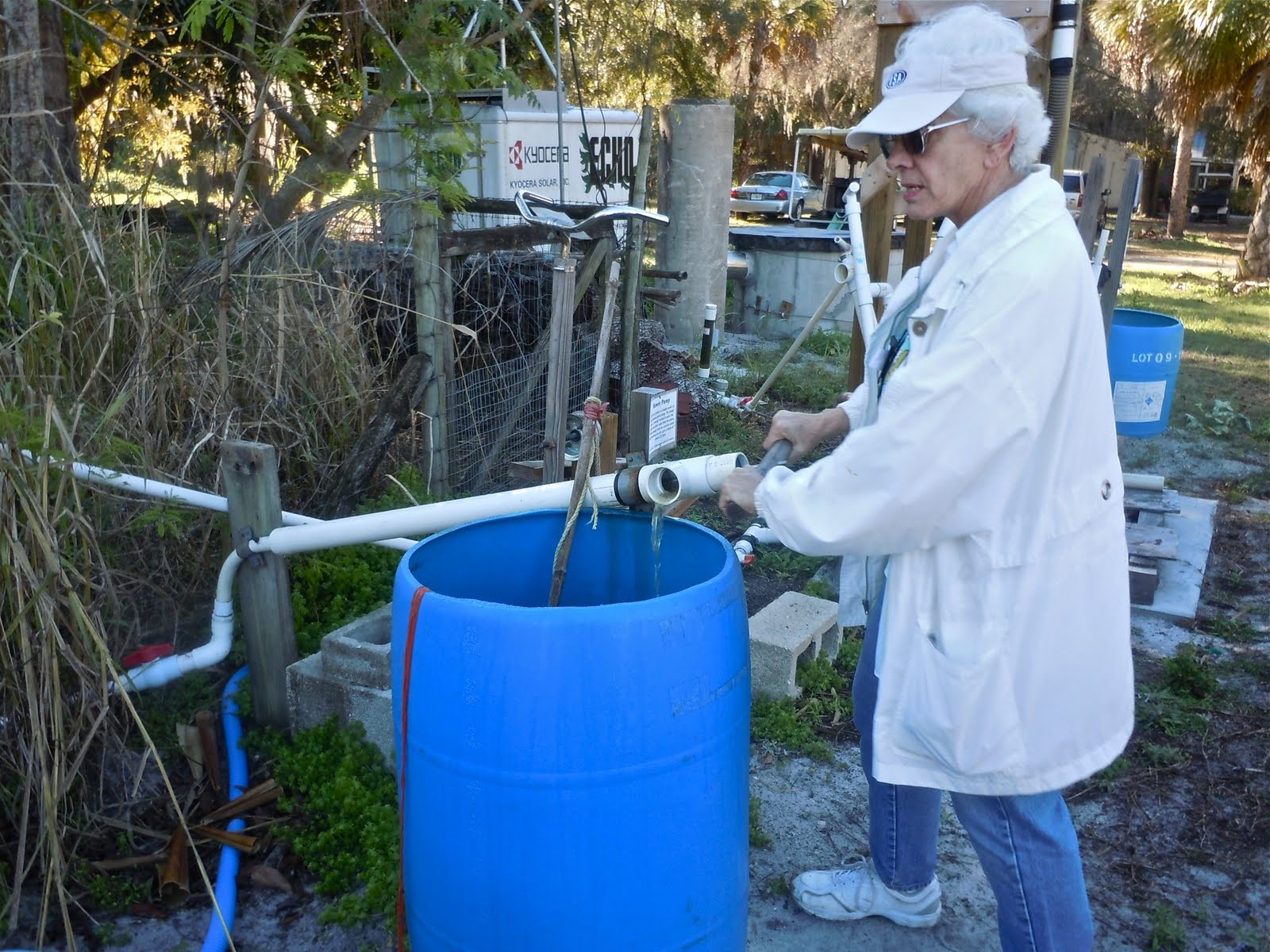 A simple hand pump setup with pvc pipe brings water from a nearby pond/stream to a container for irrigation
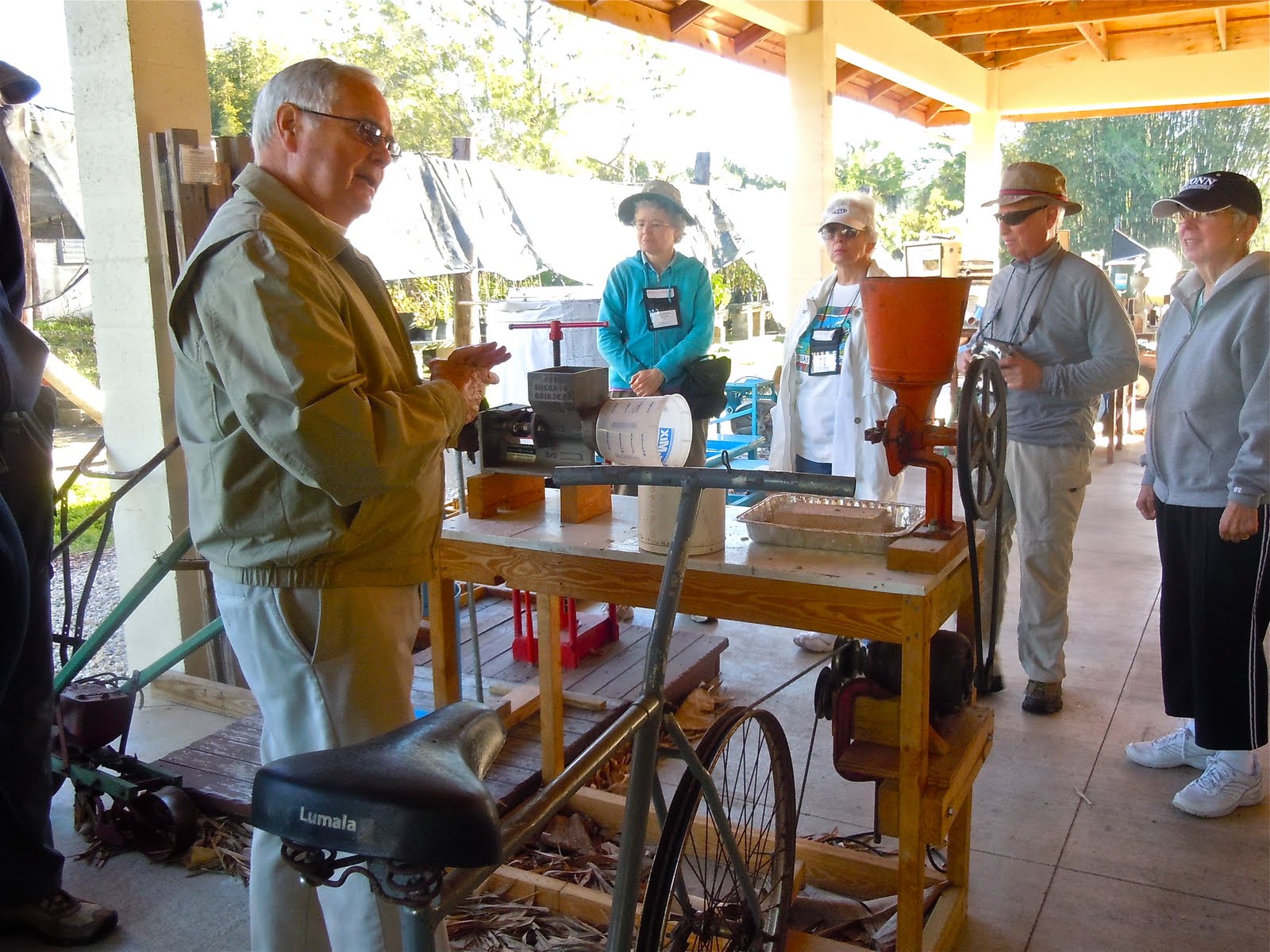 Here an old bicycle was converted to a manual motor that helps to grind grains grown in remote areas.
More on Road Scholar Service Program--ECHO
I have been back from my trip for a little over a week; it took me that long to recuperate from this lingering cold that I have been dealing with. I didn't know a person could feel so tired for so long! That is now behind me and I can show you all the stuff I have been up to and learning...
I left off at ECHO, which is such an interesting organization. Our purpose was to help out where were needed. After collecting and preparing bamboo for the fencing, we moved to another area that needed attention...mulching. Since it is a global farm compound, the amount of mulch that is required boggles the mind. So four ladies in the group formed what we called the "Mulchin' Mommas" and performed admirably! We mulched almost the entire orange grove which was huge and then we took care of the area around the store and administration buildings. The Annual Open House was weeks away so tidying the place up a little was appreciated!
 Echo makes its own mulch from the tropical plants that thrive in the area, this was not the light, tiny bits of mulch that you buy in those bags at the mega marts...this was stringy and had lots of really large chucks of dead growth in it...a challenge for us, but we were able to handle it with ease.
 Here are three of the Mulchin' Mommas happy with our progress Nancy, Me and Glory


And...wouldn't you know as soon as we finish one area a snake moves in to claim it as his territory!

We thought it might be fun to see what was going on in other sections of the farm, so we absconded with a golf cart...we had a short and fun afternoon ride around the compound before returning the cart to its "fueling station".
I left off at ECHO, which is such an interesting organization. Our purpose was to help out where were needed. After collecting and preparing bamboo for the fencing, we moved to another area that needed attention...mulching. Since it is a global farm compound, the amount of mulch that is required boggles the mind. So four ladies in the group formed what we called the "Mulchin' Mommas" and performed admirably! We mulched almost the entire orange grove which was huge and then we took care of the area around the store and administration buildings. The Annual Open House was weeks away so tidying the place up a little was appreciated!
 Echo makes its own mulch from the tropical plants that thrive in the area, this was not the light, tiny bits of mulch that you buy in those bags at the mega marts...this was stringy and had lots of really large chucks of dead growth in it...a challenge for us, but we were able to handle it with ease.
 Here are three of the Mulchin' Mommas happy with our progress Nancy, Me and Glory


And...wouldn't you know as soon as we finish one area a snake moves in to claim it as his territory!

We thought it might be fun to see what was going on in other sections of the farm, so we absconded with a golf cart...we had a short and fun afternoon ride around the compound before returning the cart to its "fueling station".
Monday, February 28, 2011
Fence Building at ECHO
I signed up for a work service program with Road Scholar to assist at the global farm of ECHO , (North Fort Myers, Florida) wherever they needed some help. I thought my efforts would be spent doing gardening work but that was not the case. One of the main areas they needed help with was renovating a bamboo fence that was a bit worn and rickety.
So, the first step is to get some bamboo. There was plenty of that growing in designated areas around the farm, all we needed to do was pull it out. Fortunately, we had at our disposal a John Deere 4-wheeler and a chain..which made the effort a lot easier.
 Here one of our Road Scholar hosts, Junior, is removing a live bamboo plant for us to strip and prepare for making into a fence slat.
 It is a bit difficult to pull one plant out of a cluster...the branches become entwined and pulling is challenging. The real fun begins when we have to remove the little branches growing along the bamboo pole; this stuff is way harder than I ever imagined. We used machetes and sometimes handsaws; the work was slow and tedious but we finally got about a hundred cleaned bamboo poles for repairing the fences around the property.

The next step is to cut them into proper lengths and deliver them to the fence repair sites. Several of us were working at each site. We had to remove the top hand-rail on the fence and re-align it so it was plumb and vertical, after that we added the newly cut bamboo to the areas that either had none or replacing those that had disintegrated.

Fortunately, we had power drills which made the job go a lot faster than if we had to do the work using an old fashioned screw-driver.
 Here is the finished product...much better than that rickety old fence and chicken wire; the ducks will not escape anymore!

So, the first step is to get some bamboo. There was plenty of that growing in designated areas around the farm, all we needed to do was pull it out. Fortunately, we had at our disposal a John Deere 4-wheeler and a chain..which made the effort a lot easier.
 Here one of our Road Scholar hosts, Junior, is removing a live bamboo plant for us to strip and prepare for making into a fence slat.
 It is a bit difficult to pull one plant out of a cluster...the branches become entwined and pulling is challenging. The real fun begins when we have to remove the little branches growing along the bamboo pole; this stuff is way harder than I ever imagined. We used machetes and sometimes handsaws; the work was slow and tedious but we finally got about a hundred cleaned bamboo poles for repairing the fences around the property.
The next step is to cut them into proper lengths and deliver them to the fence repair sites. Several of us were working at each site. We had to remove the top hand-rail on the fence and re-align it so it was plumb and vertical, after that we added the newly cut bamboo to the areas that either had none or replacing those that had disintegrated.

Fortunately, we had power drills which made the job go a lot faster than if we had to do the work using an old fashioned screw-driver.
 Here is the finished product...much better than that rickety old fence and chicken wire; the ducks will not escape anymore!
Saturday, February 19, 2011
Arkansas Snowstorm Clean-up
I started my trip on Friday, a day and a half after the two foot snowstorm that plastered Northwest Arkansas. Surprisingly, the North/South interstate was pretty clear but I found some nasty stuff as I approached Little Rock. Although none of my shots actually show the ice packed road, you can see the aftermath. It is not a pretty sight to see semi's ditched or turned over.
This first shot is of a pick-up truck with a trailer that jack-knifed. Now that the road is "clear" they can remove these vehicles. Each one of these cost me half an hour. It made my first day 12 hours instead of 8. But I did get out of the snowy areas eventually.


This fellow apparently just slid off into the median...but once there...well, he's there for a while.

This fellow not only slid into the median but also overturned. His cargo is spilled over the median and part of the highway. they were manually unloading and stacking the cargo in the road...presumably so it could be reloaded to another truck. This was my longest delay

This accident occurred in Tennessee. Most probably it included a fatality. When I passed by I could see this was almost a total demolition of at least one vehicle. That is a medivac copter sitting on the road opposite my traffic jam.
 It was very sad to see all of this destruction and suffering on my first day, but it ensured my taking special driving care throughout my trip.
This first shot is of a pick-up truck with a trailer that jack-knifed. Now that the road is "clear" they can remove these vehicles. Each one of these cost me half an hour. It made my first day 12 hours instead of 8. But I did get out of the snowy areas eventually.


This fellow apparently just slid off into the median...but once there...well, he's there for a while.

This fellow not only slid into the median but also overturned. His cargo is spilled over the median and part of the highway. they were manually unloading and stacking the cargo in the road...presumably so it could be reloaded to another truck. This was my longest delay

This accident occurred in Tennessee. Most probably it included a fatality. When I passed by I could see this was almost a total demolition of at least one vehicle. That is a medivac copter sitting on the road opposite my traffic jam.
 It was very sad to see all of this destruction and suffering on my first day, but it ensured my taking special driving care throughout my trip.
Subscribe to:
Posts (Atom)