So, I went through a serious bout with lung cancer and came out on the other side. I learned many, many things from that experience. Among them, that you truly ARE what you eat and that WHAT we eat (if we don't pay strict attention) is not all that good for us and indeed, may contribute to serious illness in the body that may be totally unnecessary. While I do not believe my cancer was caused by my diet, I do believe that my diet NOW should be the very best it can be, lest I contract some other malady that does me in.
And so, I had to convert my raised garden bed to a hoop house garden. Why? Well, the summers here are getting to be so hot that things don't grow. Oh, did I mention that organically grown vegetables are significantly higher in vitamins and much more nutrient dense than those grown in a mono-agriculture farm that is over-dosed with fertilizers? THAT, is why I have the raised bed, and the hoop house will allow me to grow stuff for 10 months out of the year, giving me great fresh and wholesome nutrition just a few steps from my door, whenever I want it.
Now anyone who knows about hoop houses, knows that they are just gardens covered with a poly film to create a kind of hot house environment to extend the seasons when things get frosty and downright cold. Mine has to do double duty. The summers here in Arkansas have gotten so hot that even watering twice a day, the sun just blisters everything. So I built a hoop house on top of my raised garden, but because I am looking to shield the sun I used a garden shade mesh instead of a poly film. In the cooler months I will switch out the mesh for a poly cover and just keep on keepin' on.
Here are a couple of pictures of the Summer version of the hoop house.
Showing posts with label Plants and Gardening. Show all posts
Tuesday, July 10, 2012
Thursday, April 21, 2011
Hobbs Conservation Area - Shaddox Hollow Trail
Today, I went with a group sponsored by OLLI for a hike at Hobbs State Park Conservation Area on the Shaddox Hollow Trail which is a loop trail 1.5 miles in length. It was my first real outing since my accident and I was concerned about my ability to handle it, but it went pretty well. I did the hike and enjoyed the cruise around Beaver lake on a pontoon boat, then lunch at War Eagle's Bean Palace. We caught a thunderstorm for our return trip, but our driver handled it very well. I have to admit that I was pretty tired when I got home and a little achy, but I am hoping that I am healing well and will be getting better as time passes. I know I am much better than I was when I first got home from the accident a month ago.
What was really special about the hike today was that there were so many wildflowers blooming. I felt like I was walking through the pages of a Tim Ernst book...wildflowers everywhere! So without further ado, here are some of the shots I got on our hike:
I will attempt to label them, but I know very few plants...any help is appreciated!
We took a group vote on these and concluded that they are phlox...
This is wild Iris, and just too pretty to behold!
A sassafras sprouting..what makes this unique is that (if you look closely) there are actually 5 different shaped leaves coming up from the same plant...most unusual!
Jack in the Pulpit, so...amazing
ok...here is where I can use a little help
A mayapple bloom
Half the group (including me) had already walked right past this fellow...probably only six or so inches away from our feet was this Pygmy Rattlesnake; fortunately someone in the group asked "what kind of snake is this"? Yes, it is as poisonous as a copperhead. He was ready to strike into action, but fortunately none of our group gave him (her) a reason to.
A little more identification help needed here...
What was really special about the hike today was that there were so many wildflowers blooming. I felt like I was walking through the pages of a Tim Ernst book...wildflowers everywhere! So without further ado, here are some of the shots I got on our hike:
I will attempt to label them, but I know very few plants...any help is appreciated!
We took a group vote on these and concluded that they are phlox...
This is wild Iris, and just too pretty to behold!
A sassafras sprouting..what makes this unique is that (if you look closely) there are actually 5 different shaped leaves coming up from the same plant...most unusual!
Jack in the Pulpit, so...amazing
ok...here is where I can use a little help
A mayapple bloom
Half the group (including me) had already walked right past this fellow...probably only six or so inches away from our feet was this Pygmy Rattlesnake; fortunately someone in the group asked "what kind of snake is this"? Yes, it is as poisonous as a copperhead. He was ready to strike into action, but fortunately none of our group gave him (her) a reason to.
A little more identification help needed here...
Monday, March 7, 2011
Plants Worth Knowing
I found out about two plants that are so remarkable on my service program that I had to share them with you here on the blog. Prior to the program I had never heard of either of these plants and yet, they are so phenomenal I can only wonder why not.
First one is called Moringa;it has amazing nutritional value. In the dry or powdered state, the leaves contain 27% protein, 38% carbohydrate and 19% fiber, an amazing distribution. Further virtually the whole plant is edible. The roots may be ground and made into a replacement for horseradish, the leaves may be eaten fresh or cooked, the flowers may be eaten or made into tea, the young tender pods may be eaten as one might eat gen beans or asparagus and the immature seeds may be cooked and eaten as you would garden peas.
The powder form seems to be most interesting. Harvested moringa leaves are dried and ground into a fine powder, which is used as a highly-nutritious food additive. This has become important in child nutrition programs all over the world. Moringa is added to the basic staple the child is accustomed to eating (rice, potatoes maize, poi or cassava for example) and the child readily accepts the nutritious addition to his/her meal. In the Philippines whee the leaves are cooked and fed to children, moringa is known as mothers best friend.
Moringa is a tree of many uses. In addition to human dietary benefits, moringa leaves can be used as animal forage, green manure, to make biogas a domestic cleaning agent and a growth hormone that can increase some crop yields up to 30%. The bark of the moringa tree yields fiber to make rope and mats and the sap or gum from the bark is used in medicines and condiments; together the bark and gum are used to tan hides.
The tree itself is an important resource in alley cropping and as a living fence. The wood is used as paper pulp and produces a natural blue dye. Further nearly every part of the tree is used to make a wide variety of traditional medicines. Additional information about Moringa can be found by clicking the link.
The second plant that is equally astounding is called Neem. This is presumed to have begun in India. Ayurvedic Medicine, the Indian system of healing of at least 6,000 years has long prescribed Neem for a variety of health and beauty problems. Today, Neem has been introduced to many other countries and its popularity continues to grow because it has proven to be a safe, effective treatment to many ailments.
Current scientific research is convincing many Westerners what Ayurvedic doctors have known for centuries - that neem is a great remedy for numerous health problems and promotes overall well-being. Such as:
Burns - neem cream over the affected area reduces pain and kills bacteria, thereby promoting faster healing and less scaring.
Sprains and Bruises - neem cream increases blood flow to the area, reducing swelling and discoloration.
Headache - chew on a few leaves or drink a tea made with some leaves to reduce pain, blood pressure and open constricted blood vessels.
Psoriasis- perhaps the best weapon against psoriasis. Patients have reported that neem extracts or seed oil applied topically were as effective or better than cortisone and did not produce side effects.
Wrinkles - the same compounds that treat psoriasis also help in maintaining the skin's suppleness. Apply a small amount of neem cream after washing and drying the skin.
Teeth and gums - a daily application of neem mouthrinse has yielded improvements in tooth decal, bleeding, sore gums and infections. Neem has also prevented cavities in millions of South Asians in spite of the lack of "modern" dental care.
Both of these products can be purchased by using a search engine online.
First one is called Moringa;it has amazing nutritional value. In the dry or powdered state, the leaves contain 27% protein, 38% carbohydrate and 19% fiber, an amazing distribution. Further virtually the whole plant is edible. The roots may be ground and made into a replacement for horseradish, the leaves may be eaten fresh or cooked, the flowers may be eaten or made into tea, the young tender pods may be eaten as one might eat gen beans or asparagus and the immature seeds may be cooked and eaten as you would garden peas.
The powder form seems to be most interesting. Harvested moringa leaves are dried and ground into a fine powder, which is used as a highly-nutritious food additive. This has become important in child nutrition programs all over the world. Moringa is added to the basic staple the child is accustomed to eating (rice, potatoes maize, poi or cassava for example) and the child readily accepts the nutritious addition to his/her meal. In the Philippines whee the leaves are cooked and fed to children, moringa is known as mothers best friend.
Moringa is a tree of many uses. In addition to human dietary benefits, moringa leaves can be used as animal forage, green manure, to make biogas a domestic cleaning agent and a growth hormone that can increase some crop yields up to 30%. The bark of the moringa tree yields fiber to make rope and mats and the sap or gum from the bark is used in medicines and condiments; together the bark and gum are used to tan hides.
The tree itself is an important resource in alley cropping and as a living fence. The wood is used as paper pulp and produces a natural blue dye. Further nearly every part of the tree is used to make a wide variety of traditional medicines. Additional information about Moringa can be found by clicking the link.
The second plant that is equally astounding is called Neem. This is presumed to have begun in India. Ayurvedic Medicine, the Indian system of healing of at least 6,000 years has long prescribed Neem for a variety of health and beauty problems. Today, Neem has been introduced to many other countries and its popularity continues to grow because it has proven to be a safe, effective treatment to many ailments.
Current scientific research is convincing many Westerners what Ayurvedic doctors have known for centuries - that neem is a great remedy for numerous health problems and promotes overall well-being. Such as:
Burns - neem cream over the affected area reduces pain and kills bacteria, thereby promoting faster healing and less scaring.
Sprains and Bruises - neem cream increases blood flow to the area, reducing swelling and discoloration.
Headache - chew on a few leaves or drink a tea made with some leaves to reduce pain, blood pressure and open constricted blood vessels.
Psoriasis- perhaps the best weapon against psoriasis. Patients have reported that neem extracts or seed oil applied topically were as effective or better than cortisone and did not produce side effects.
Wrinkles - the same compounds that treat psoriasis also help in maintaining the skin's suppleness. Apply a small amount of neem cream after washing and drying the skin.
Teeth and gums - a daily application of neem mouthrinse has yielded improvements in tooth decal, bleeding, sore gums and infections. Neem has also prevented cavities in millions of South Asians in spite of the lack of "modern" dental care.
Both of these products can be purchased by using a search engine online.
Sunday, March 6, 2011
ECHO -- Educational Concerns for Hunger Organization
ECHO That's the name of the non-profit organization that I spent a week doing a service program in February. (See other recent posts to understand the activities that were performed in the service program.) The organization is so powerful and all-encompassing that the name hardly does it justice.
Physically it is located in North Fort Myers, Florida. It has a global demonstration farm which functions as a living classroom that is focused on helping the poor farmer overseas become more productive. It has a variety of farm environments: tropical, desert, mountainous, swampy or overly wet and urban. In each area of the global farm, plants are tested and developed to grow in specific harsh environments. Once successful in harvesting healthy nutritious plants, seeds are painstakingly separated and packaged.

The farm provides a laboratory for developing seeds, growing, harvesting, pest control, erosion and irrigation methods which are then documented and shared with agricultural workers throughout the world in order to help reduce hunger in the world.
The organization networks with members worldwide to share information and seeds to help in areas where hunger is a serious problem. The demonstration farm is one resource that allows them to provide tailored options for missionaries and agricultural workers in 180 countries. They do not send workers out; they assist those already in the field.
Their seed bank contains over 350 varieties of vegetables, multi-purpose trees, fruits and other tropical crops. These plants hold special potential for producing under difficult conditions: where it is too dry, too wet, or too hilly for most crops. The seeds are sent free to overseas developmental leaders who then report back to ECHO on performance and community acceptance of the plants. These are not hybrid seeds, so one packet can in short order become the source of thousands of seeds for the needy.
Seed drying racks specially made for ECHO
Florida volunteers separating seeds and getting them ready to package
Low tech way of packaging seeds. Hey, it works!
I was very impressed with the urban farm area. They were able to use just about anything that could hold dirt to make a garden and have healthy and nutritious plants growing. It was amazing, an old two liter coke bottle, a gallon milk container even a wal-mart plastic bag were all successful plant holders.


Some of the plants that thrive in inhospitable areas are amaranth a nutritionally packed grain

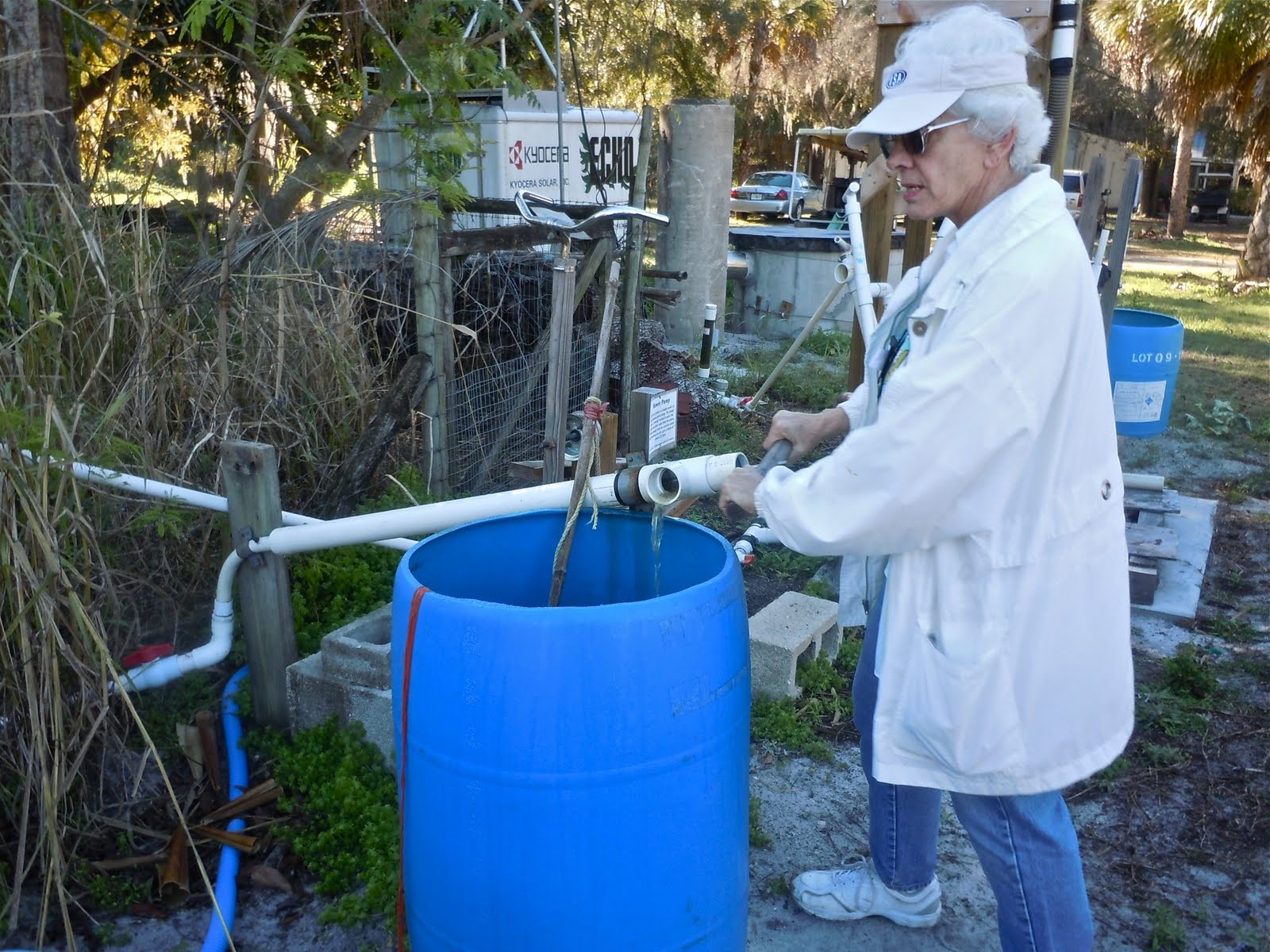
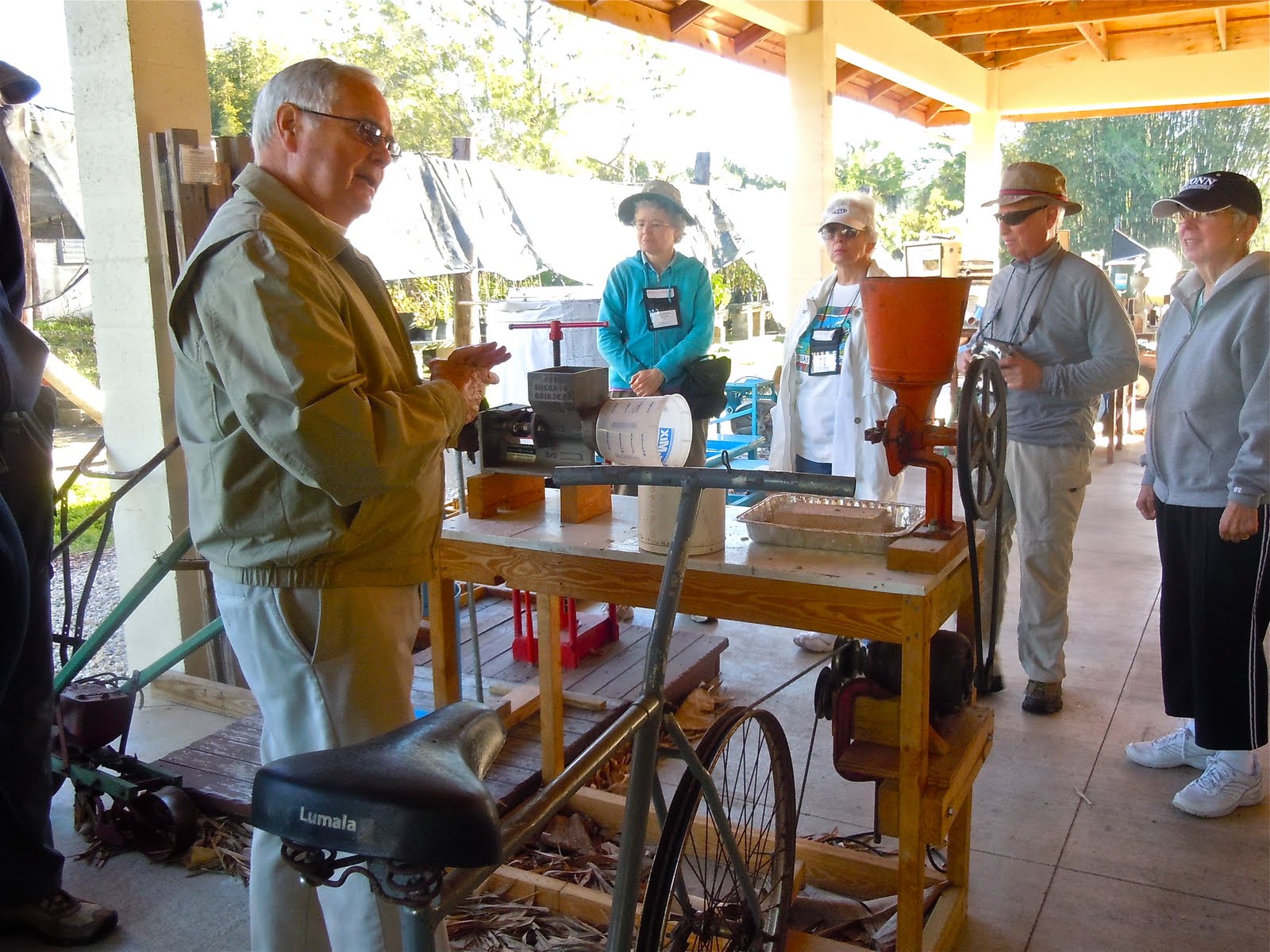
They also use what is available to produce water and grind grain, Here are only two of many examples that I saw at the farm
A simple hand pump setup with pvc pipe brings water from a nearby pond/stream to a container for irrigation
Here an old bicycle was converted to a manual motor that helps to grind grains grown in remote areas.
Physically it is located in North Fort Myers, Florida. It has a global demonstration farm which functions as a living classroom that is focused on helping the poor farmer overseas become more productive. It has a variety of farm environments: tropical, desert, mountainous, swampy or overly wet and urban. In each area of the global farm, plants are tested and developed to grow in specific harsh environments. Once successful in harvesting healthy nutritious plants, seeds are painstakingly separated and packaged.
The farm provides a laboratory for developing seeds, growing, harvesting, pest control, erosion and irrigation methods which are then documented and shared with agricultural workers throughout the world in order to help reduce hunger in the world.
The organization networks with members worldwide to share information and seeds to help in areas where hunger is a serious problem. The demonstration farm is one resource that allows them to provide tailored options for missionaries and agricultural workers in 180 countries. They do not send workers out; they assist those already in the field.
Their seed bank contains over 350 varieties of vegetables, multi-purpose trees, fruits and other tropical crops. These plants hold special potential for producing under difficult conditions: where it is too dry, too wet, or too hilly for most crops. The seeds are sent free to overseas developmental leaders who then report back to ECHO on performance and community acceptance of the plants. These are not hybrid seeds, so one packet can in short order become the source of thousands of seeds for the needy.
I was very impressed with the urban farm area. They were able to use just about anything that could hold dirt to make a garden and have healthy and nutritious plants growing. It was amazing, an old two liter coke bottle, a gallon milk container even a wal-mart plastic bag were all successful plant holders.
Some of the plants that thrive in inhospitable areas are amaranth a nutritionally packed grain
They also use what is available to produce water and grind grain, Here are only two of many examples that I saw at the farm
Labels:
Florida Travels,
Plants and Gardening,
Road Scholar
More on Road Scholar Service Program--ECHO
I have been back from my trip for a little over a week; it took me that long to recuperate from this lingering cold that I have been dealing with. I didn't know a person could feel so tired for so long! That is now behind me and I can show you all the stuff I have been up to and learning...
I left off at ECHO, which is such an interesting organization. Our purpose was to help out where were needed. After collecting and preparing bamboo for the fencing, we moved to another area that needed attention...mulching. Since it is a global farm compound, the amount of mulch that is required boggles the mind. So four ladies in the group formed what we called the "Mulchin' Mommas" and performed admirably! We mulched almost the entire orange grove which was huge and then we took care of the area around the store and administration buildings. The Annual Open House was weeks away so tidying the place up a little was appreciated!
Echo makes its own mulch from the tropical plants that thrive in the area, this was not the light, tiny bits of mulch that you buy in those bags at the mega marts...this was stringy and had lots of really large chucks of dead growth in it...a challenge for us, but we were able to handle it with ease.
Here are three of the Mulchin' Mommas happy with our progress Nancy, Me and Glory


And...wouldn't you know as soon as we finish one area a snake moves in to claim it as his territory!

We thought it might be fun to see what was going on in other sections of the farm, so we absconded with a golf cart...we had a short and fun afternoon ride around the compound before returning the cart to its "fueling station".
I left off at ECHO, which is such an interesting organization. Our purpose was to help out where were needed. After collecting and preparing bamboo for the fencing, we moved to another area that needed attention...mulching. Since it is a global farm compound, the amount of mulch that is required boggles the mind. So four ladies in the group formed what we called the "Mulchin' Mommas" and performed admirably! We mulched almost the entire orange grove which was huge and then we took care of the area around the store and administration buildings. The Annual Open House was weeks away so tidying the place up a little was appreciated!
And...wouldn't you know as soon as we finish one area a snake moves in to claim it as his territory!
We thought it might be fun to see what was going on in other sections of the farm, so we absconded with a golf cart...we had a short and fun afternoon ride around the compound before returning the cart to its "fueling station".
Labels:
Florida Travels,
Plants and Gardening,
Road Scholar
Friday, September 26, 2008
Back Home
We got back to my place Wednesday afternoon and as expected all of my garden areas were grossly overgrown with weeds and grass. No matter how much mulch I put down, it still pops through. Oh well, this is the price one pays for trying to have more than one thing growing simultaneously in the yard.
I was REALLY interested to see how my fig trees made out. I planted them two years ago. The first spring we had a nasty and long freeze in April and wasn't sure that they would survive. But when I got to the back yard I was pleasantly surprised! Of the three I planted, they all were doing well. The middle one was taller than my 6 foot fence, so I think they have dug in and will be with me a while.

Then I went over for a closer look (since this was the only growing thing in my yard that I was happy with) Oh boy...figs all over it! Not big enough or ripe enough but I know the signs of a healthy tree and next year promised figs aplenty.
Then as I was admiring the tree I noticed something else...do you see it there on the ground between the fig stalks?
Well, do you see it now?
Yep...it's a snake alright, and now he is letting me know that he is not at all happy that I have disturbed his little siesta!

Yes, my dear little snake...all good things come to an end. You just go along and find another place to take up residence.
I was REALLY interested to see how my fig trees made out. I planted them two years ago. The first spring we had a nasty and long freeze in April and wasn't sure that they would survive. But when I got to the back yard I was pleasantly surprised! Of the three I planted, they all were doing well. The middle one was taller than my 6 foot fence, so I think they have dug in and will be with me a while.
Then I went over for a closer look (since this was the only growing thing in my yard that I was happy with) Oh boy...figs all over it! Not big enough or ripe enough but I know the signs of a healthy tree and next year promised figs aplenty.
Then as I was admiring the tree I noticed something else...do you see it there on the ground between the fig stalks?
Yep...it's a snake alright, and now he is letting me know that he is not at all happy that I have disturbed his little siesta!
Yes, my dear little snake...all good things come to an end. You just go along and find another place to take up residence.
Wednesday, August 6, 2008
Wildflowers in Grant Woods
Chuck and I biked Grant Woods Forest Preserve This is a beautiful wooded area with open prairies and some up and downs; if I were to complain (which I'm not) the trails are a bit short. We rode the street trails in and around Fox Lake to end up with a 15 mile day.
What I really like about this preserve is the diversity of plants. Today my topic is the flowering plants in Grant Woods. Now these may actually be weeds, but since they are all beautiful and growing together I will call them wildflowers
See for yourself click on a picture to enlarge it...
This grass was so pretty, I had to get a shot. I have since found out it is called Bottlebrush grass and is Uncommon.
Grass seedbeard spraying over a field of yellow coneflowers.
This white one caught my eye, click on it to see it enlarged...it is really quite spectacular. I could not find a name for though.
If you click on this light purple flower and look in the 7 o'clock position, you will see a large daddy long legs spider.


There is a bumblebee in the 9 o'clock position on the Purple Joe Pye Weed...having some fun. The status of this plant is Uncommon, also.
Look in the upper right part of the flower...there is a lightning bug there. It's the first time I ever saw one during the day!
What I really like about this preserve is the diversity of plants. Today my topic is the flowering plants in Grant Woods. Now these may actually be weeds, but since they are all beautiful and growing together I will call them wildflowers
See for yourself click on a picture to enlarge it...
This grass was so pretty, I had to get a shot. I have since found out it is called Bottlebrush grass and is Uncommon.
Grass seedbeard spraying over a field of yellow coneflowers.
This white one caught my eye, click on it to see it enlarged...it is really quite spectacular. I could not find a name for though.
If you click on this light purple flower and look in the 7 o'clock position, you will see a large daddy long legs spider.

There is a bumblebee in the 9 o'clock position on the Purple Joe Pye Weed...having some fun. The status of this plant is Uncommon, also.
Look in the upper right part of the flower...there is a lightning bug there. It's the first time I ever saw one during the day!
Thursday, July 31, 2008
Wauconda Farmers Market
Today we got out early and biked for 13 miles on the trail behind the condo since the weather guys were threatening that it would be in the 90's and humid. Having finished the ride, I can say that I have completed over 400 miles for the month of July and only a few miles short of 1500 for the year so far.
I only started seriously biking last fall and at that time it was a real effort to get anywhere near 10 miles on any outing. Now I occasionally do 30 or more, quite an improvement. I find this is great exercise and something that I don't tire of, so it should be something that I take with me as I approach those so called golden years.
Then in the afternoon, we went to the Farmers market in town. They had some really nice stuff,


but what caught my eye was this bi-color corn that is claimed to be so good you can eat it raw. Well, indeed you can. It reminded me of some of the sweet white corn I used to get from the farms in New Jersey. That was picked just minutes before they sold it to you and was as sweet as candy. This was as good. See for yourself.

I only started seriously biking last fall and at that time it was a real effort to get anywhere near 10 miles on any outing. Now I occasionally do 30 or more, quite an improvement. I find this is great exercise and something that I don't tire of, so it should be something that I take with me as I approach those so called golden years.
Then in the afternoon, we went to the Farmers market in town. They had some really nice stuff,


but what caught my eye was this bi-color corn that is claimed to be so good you can eat it raw. Well, indeed you can. It reminded me of some of the sweet white corn I used to get from the farms in New Jersey. That was picked just minutes before they sold it to you and was as sweet as candy. This was as good. See for yourself.

Labels:
Biking,
Illinois Travels,
Plants and Gardening
Thursday, May 22, 2008
Time to Plant
We decided that it was time to brighten the plantable areas around the townhouse here in Wauconda, while the weather is still cool.
Look here on the side entry...there was apparently something here a year or two ago that was nice but it didn't make it through the harsh winter of 2007-2008. Now there is only a weedy ground cover. That had to go for something better.


Then in the front, there just wasn't any color. Now all that has changed. It looks like we have created a nice welcome to spring.

Now, bring us some warmer weather!!!! Please!
Look here on the side entry...there was apparently something here a year or two ago that was nice but it didn't make it through the harsh winter of 2007-2008. Now there is only a weedy ground cover. That had to go for something better.


Then in the front, there just wasn't any color. Now all that has changed. It looks like we have created a nice welcome to spring.

Now, bring us some warmer weather!!!! Please!
Subscribe to:
Posts (Atom)